
AI Tools
What Are AI Tools? The Complete Business Guide for 2026
Artificial intelligence has quietly moved from being a “nice-to-have” to a core part of how modern businesses operate. What once required large teams, significant time, and manual effort can now be done faster, more accurately, and at scale with the help of AI tools for business.
In fact, adoption is accelerating rapidly. According to McKinsey & Company, around 78% of companies are already using AI or related technologies. This shift is not limited to large enterprises anymore. Today, artificial intelligence tools are being used by startups, small businesses, and growing teams to improve efficiency and decision-making.
From content creation and data analysis to customer interactions and workflow automation, AI software for business is transforming how work gets done. Businesses are using AI writing tools, AI chatbots, and AI automation systems to reduce manual effort, improve speed, and scale operations more effectively.
But with so many options and rapid innovation, it’s easy to get confused. What exactly is the AI tools definition in a business context? What do these tools actually do, and how do they fit into everyday workflows?
This guide answers those questions in a clear, practical way.
Instead of just theory, we’ll walk through business AI tools explained step by step, including how they work, the different types available, real-world use cases, and how to choose the right tools for your needs.
Whether you’re just starting out or looking to use AI more strategically, this guide will help you understand how AI tools for business are shaping the future of work in 2026 and beyond.
What Are AI Tools for Business?
Artificial intelligence is no longer something businesses are “experimenting” with; it’s becoming a core part of how modern companies operate. From automating repetitive tasks to generating content and analyzing massive datasets, AI tools are quietly reshaping everyday business workflows.
So, what are AI tools for business?
At a fundamental level, AI tools are software systems that use artificial intelligence to perform tasks that would normally require human intelligence. These tasks can range from understanding language and recognizing patterns to making decisions and generating outputs.
But that definition only tells part of the story.
What makes AI tools truly powerful is not just what they do but how they do it. Unlike traditional software, which follows fixed instructions, AI tools are designed to learn from data, adapt over time, and improve their performance without constant human intervention.
This shift from static tools to learning systems is what makes artificial intelligence tools so valuable in a business context.
How AI Tools Actually Create Value
To understand business AI tools explained in a practical way, it helps to break down what’s happening behind the scenes.
Every effective AI system is built around three core capabilities: learning, decision-making, and automation.
First, there is the ability to learn from data. AI tools analyze large volumes of information, such as customer behavior, transaction history, and interactions, and identify patterns within it. Over time, this allows the system to refine its outputs and become more accurate. This is why AI tools tend to improve the more they are used.
Second, AI tools are capable of making decisions. Instead of just presenting data, they interpret it. For example, an AI system can determine which leads are most likely to convert, which products should be recommended, or which campaigns are underperforming.
Finally, there is automation. AI tools can take over repetitive and time-consuming tasks, executing them consistently without fatigue. But unlike traditional automation, these systems can adapt to different scenarios and improve their performance over time.
When these three capabilities come together, AI tools become more than just software—they become systems that actively contribute to business growth.
How AI Tools Work (Simplified)
Even though AI can seem complex, the way AI tools function follows a relatively simple structure.
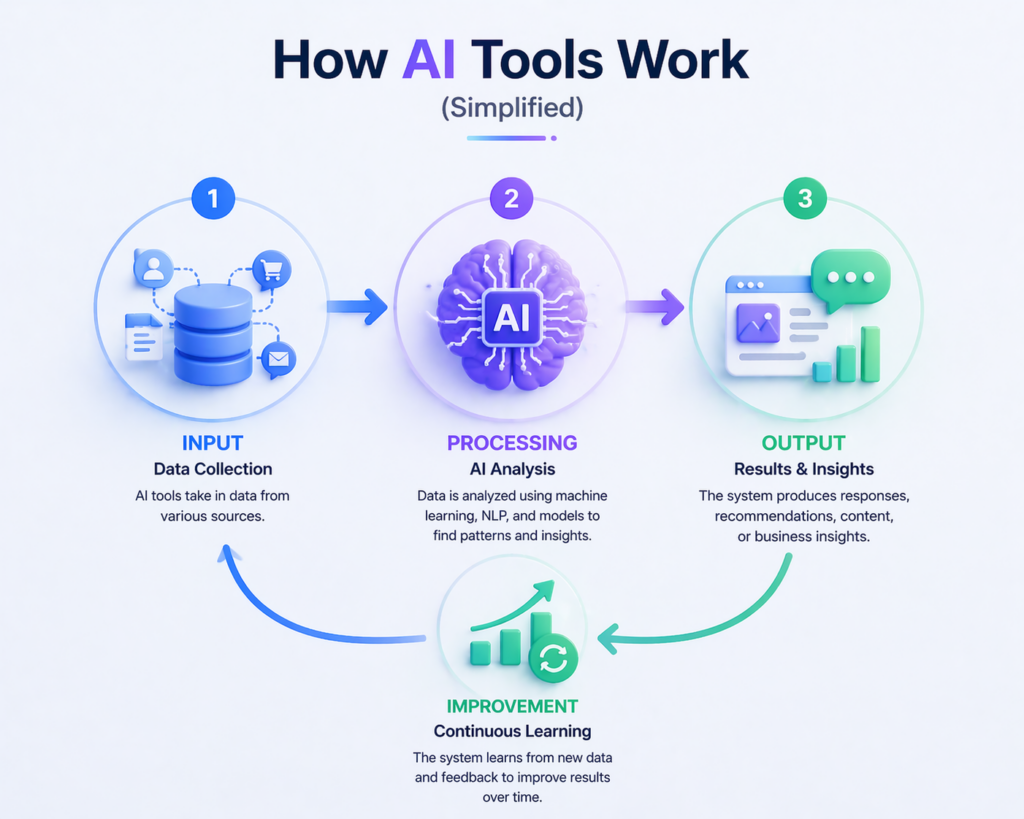
At a high level, every AI system operates through three stages: input, processing, and output.
It starts with data. Businesses generate data constantly—through customer interactions, website activity, emails, and transactions. AI tools take this data as input.
This data is then processed using technologies like machine learning, which helps the system identify patterns and improve predictions over time. When dealing with language, natural language processing allows the system to understand and generate human-like text. More advanced tools rely on large language models, which are trained on massive datasets to produce context-aware responses.
Once the data has been processed, the system produces an output. This could be a chatbot response, a generated article, a recommendation, or a business insight.
What makes this process powerful is that it doesn’t stop after one cycle. The system continuously learns from new data and feedback, improving its outputs over time.
In simple terms, AI tools operate in a loop:
Data → Analysis → Output → Improvement
And this continuous loop is what allows businesses to scale intelligence across their operations.
Types of AI Tools Businesses Use
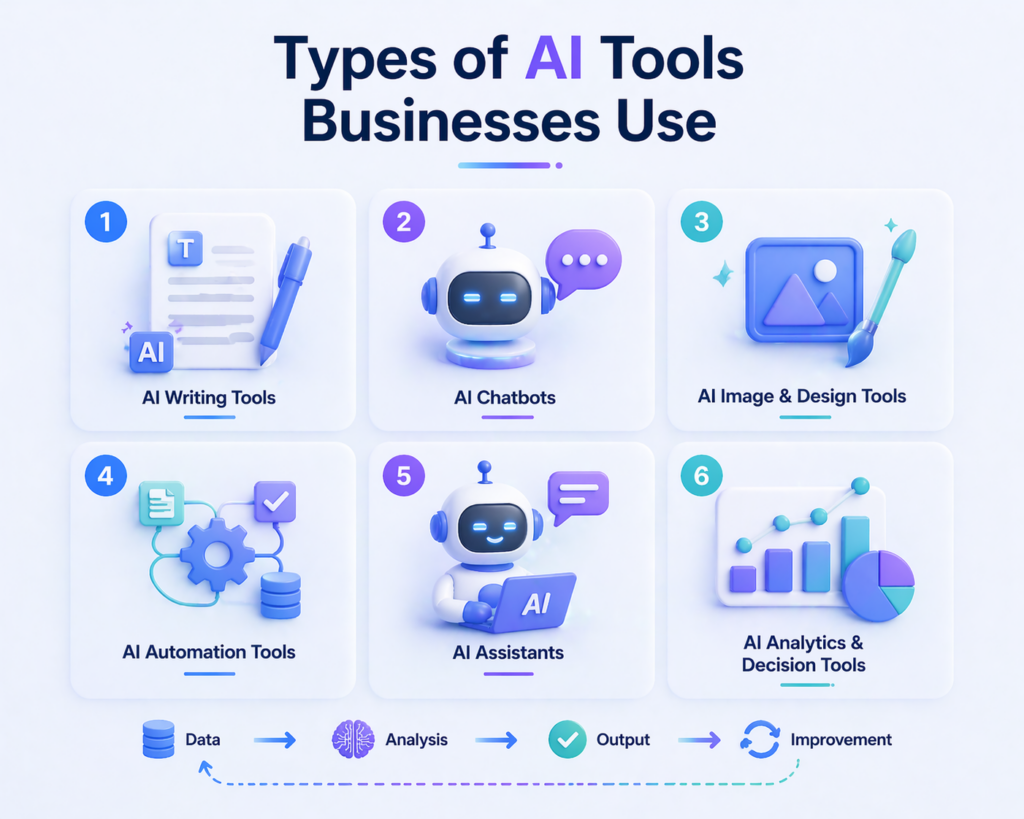
AI tools are not limited to a single function. They exist across different areas of a business, each designed to solve a specific problem. Understanding these categories makes it easier to see where AI can create the most impact.
AI Writing Tools
Content is one of the biggest drivers of modern business—whether it’s marketing campaigns, emails, product descriptions, or blog posts. But producing content consistently is often time-consuming and difficult to scale.
This is where AI writing tools come in.
These tools assist in generating written content quickly, allowing businesses to keep up with demand without overwhelming their teams. Instead of starting from scratch, marketers and content teams can generate drafts, refine messaging, and repurpose content across multiple channels.
For example, a business running paid ads might need multiple variations of ad copy. An AI writing tool can generate several options within minutes, which can then be edited and optimized. The goal isn’t to replace human creativity—but to remove the bottleneck that slows it down.
AI Chatbots
Customer expectations have changed significantly. People expect instant responses and seamless interactions, regardless of the time of day.
AI chatbots help businesses meet these expectations by handling conversations in real time.
They can answer common questions, guide users through a website, and even assist with purchases. For businesses dealing with high volumes of customer inquiries, this can significantly reduce the workload on support teams.
More importantly, chatbots ensure that customers are not left waiting. Even outside of business hours, queries can be handled instantly, improving the overall experience.
AI Image and Design Tools
Visual content has become essential in marketing, but traditional design workflows can be slow and resource-intensive.
AI image generation tools are changing that dynamic.
These tools allow businesses to create visuals quickly—whether it’s ad creatives, social media graphics, or product images. Instead of relying entirely on manual design processes, teams can generate multiple variations and test what works best.
This speed and flexibility make it easier for businesses to experiment and optimize their creative output.
AI Automation Tools
Every business relies on processes, many of which involve repetitive tasks that don’t require strategic thinking.
AI automation tools focus on eliminating these inefficiencies.
They can manage workflows, transfer data between systems, and trigger actions automatically. For example, when a new lead enters a system, it can be assigned, followed up, and tracked without manual intervention.
This not only saves time but also ensures consistency and reduces errors.
AI Assistants
As businesses become more complex, managing tasks, information, and communication becomes increasingly challenging.
AI assistants act as digital helpers that support day-to-day productivity.
They can summarize documents, draft emails, schedule meetings, and retrieve information quickly. For professionals handling multiple responsibilities, this can significantly reduce mental load and improve efficiency.
AI Analytics and Decision Tools
Data is one of the most valuable assets a business has, but only if it can be used effectively.
AI-powered analytics tools transform raw data into meaningful insights.
They help businesses understand trends, predict outcomes, and make informed decisions. Instead of relying on guesswork, companies can base their strategies on real data.
This shift toward data-driven decision-making is one of the most important roles AI tools play in modern business.
What Do AI Tools Do?
To answer the question “what do AI tools do” in a meaningful way, it’s important to move beyond features and focus on outcomes.
At their core, AI tools change how work gets done.
They remove the need for repetitive manual effort, allowing teams to focus on higher-value activities. Tasks like responding to customer queries, updating records, or scheduling processes can be handled automatically.
They also make it possible to analyze data at a scale that would be impossible manually. Businesses generate large volumes of data every day, and AI tools can process this information quickly, uncovering patterns and insights.
Another major function is content generation. Whether it’s writing, design, or communication, AI tools enable businesses to produce content consistently without overextending resources.
Perhaps most importantly, AI tools improve decision-making. By providing real-time insights and predictions, they allow businesses to act proactively instead of reactively.
And finally, they enhance customer experience—through personalization, faster responses, and more relevant interactions.
Key Technologies Behind AI Tools
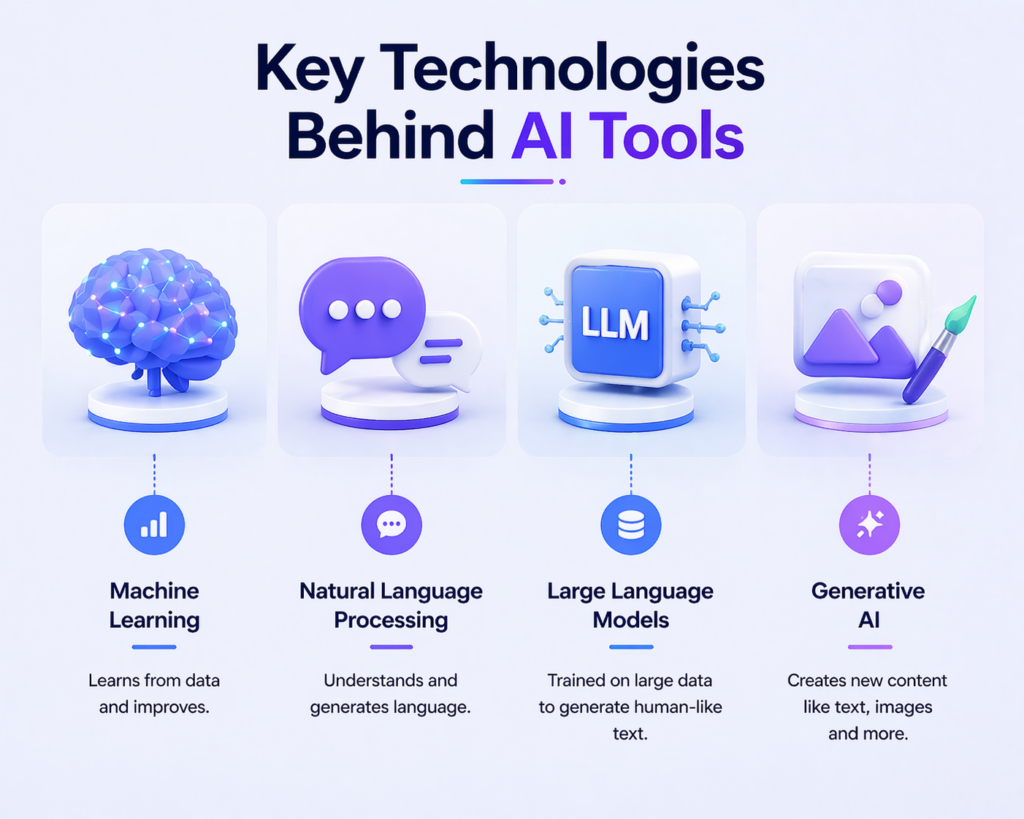
Behind every AI tool is a set of core technologies that power how it learns, processes information, and generates results. You don’t need a technical background to understand them, but knowing the basics helps you see how these systems actually work.
The foundation of most AI tools. It enables systems to learn from data, recognize patterns, and improve performance over time without manual updates.
Allows AI tools to understand, interpret, and generate human language. This is what powers chatbots, AI writing tools, and virtual assistants.
Advanced AI systems trained on massive datasets. They can generate human-like text, understand context, and hold conversations that feel natural and relevant.
Focuses on creating new content rather than just analyzing data. It enables AI tools to produce text, images, code, and other outputs based on prompts.
Key Benefits of AI Tools for Business
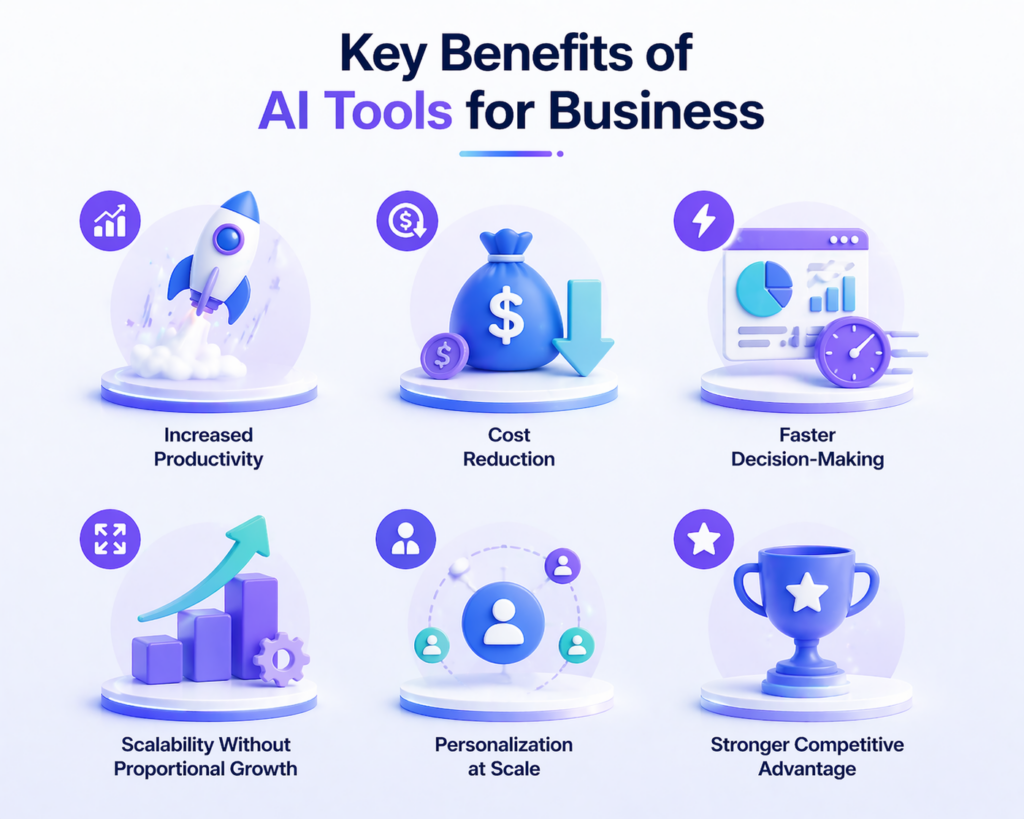
The rapid adoption of AI tools is largely driven by the real, measurable advantages they offer across different areas of a business. Instead of just improving one function, these tools create impact at multiple levels.
- Increased Productivity
AI tools significantly reduce the time required to complete tasks. Work that once took hours—like writing content, analyzing data, or responding to queries—can now be done in minutes, allowing teams to focus on higher-value activities.
- Cost Reduction
By automating repetitive processes and minimizing manual effort, businesses can lower operational costs. This is especially valuable in areas like customer support, data processing, and content production.
- Faster Decision-Mak
AI tools provide real-time insights and data analysis, enabling businesses to make quicker and more informed decisions instead of relying on delayed reports or guesswork.
- Scalability Without Proportional Growth
As a business grows, AI tools allow it to handle increased workloads without needing to expand teams at the same rate, making growth more efficient and sustainable.
- Personalization at Scale
AI enables businesses to tailor experiences for individual users, from product recommendations to personalized communication, improving engagement and customer satisfaction.
- Stronger Competitive Advantage
Businesses that adopt AI tools early are better positioned to adapt to market changes, optimize operations, and stay ahead of competitors in an increasingly digital landscape.
Use Cases of AI Tools in Business
Understanding AI tools becomes much easier when you see how they are actually used inside businesses. Rather than thinking of AI as a single solution, it’s more useful to look at how different departments apply it to solve real problems.
Marketing: Scaling Content and Optimizing Performance
Marketing is one of the earliest and most aggressive adopters of AI tools—and for good reason.
AI has fundamentally changed how content is created and how campaigns are optimized. Instead of relying entirely on manual effort, marketing teams now use AI tools to generate blog posts, ad copy, email campaigns, and social media content at scale.
Beyond content creation, AI also plays a critical role in ad optimization. It can analyze performance data in real time, identify which creatives are working, and automatically adjust targeting or budgets.
In practical terms, this means:
- Faster campaign launches
- Continuous optimization without manual intervention
- Better return on ad spend
Sales: Smarter Lead Prioritization and CRM Automation
Sales teams deal with one core challenge—knowing where to focus their efforts.
AI tools help solve this through lead scoring and CRM automation. Instead of treating every lead equally, AI systems analyze behavior, engagement, and past data to identify which prospects are most likely to convert.
This allows sales teams to:
- Prioritize high-value leads
- Reduce time wasted on low-quality prospects
- Close deals more efficiently
AI also automates repetitive CRM tasks such as updating records, scheduling follow-ups, and tracking interactions. This ensures that the system stays updated without requiring constant manual input.
Customer Support: Faster, Always-On Assistance
Customer support is another area where AI tools deliver immediate value.
AI chatbots can handle a large percentage of customer queries without human involvement. These include common questions related to orders, policies, and product information.
The biggest advantage here is availability.
Customers no longer have to wait for business hours to get answers. AI systems provide instant responses, improving satisfaction while reducing the workload on support teams.
Human agents can then focus on more complex or sensitive issues, creating a better overall support system.
Operations: Streamlining Workflows
Behind the scenes, operations teams deal with processes that keep the business running. Many of these processes involve repetitive steps that can slow things down.
AI tools help by introducing workflow automation.
For example, when a new order is placed or a lead is captured, the system can automatically trigger a series of actions—assign tasks, send notifications, update systems, and more.
This reduces delays, minimizes errors, and ensures that operations run smoothly without constant oversight.
HR: Smarter Hiring and Screening
Hiring is one of the most time-consuming processes for any organization.
AI tools are now being used to screen resumes, shortlist candidates, and even assist in initial evaluations. Instead of manually reviewing hundreds of applications, HR teams can use AI to identify candidates that best match the role.
This doesn’t replace human judgment—but it significantly reduces the time required to reach that stage.
The result is:
- Faster hiring cycles
- Better candidate matching
- Reduced administrative workload
Popular AI Tools for Business in 2026
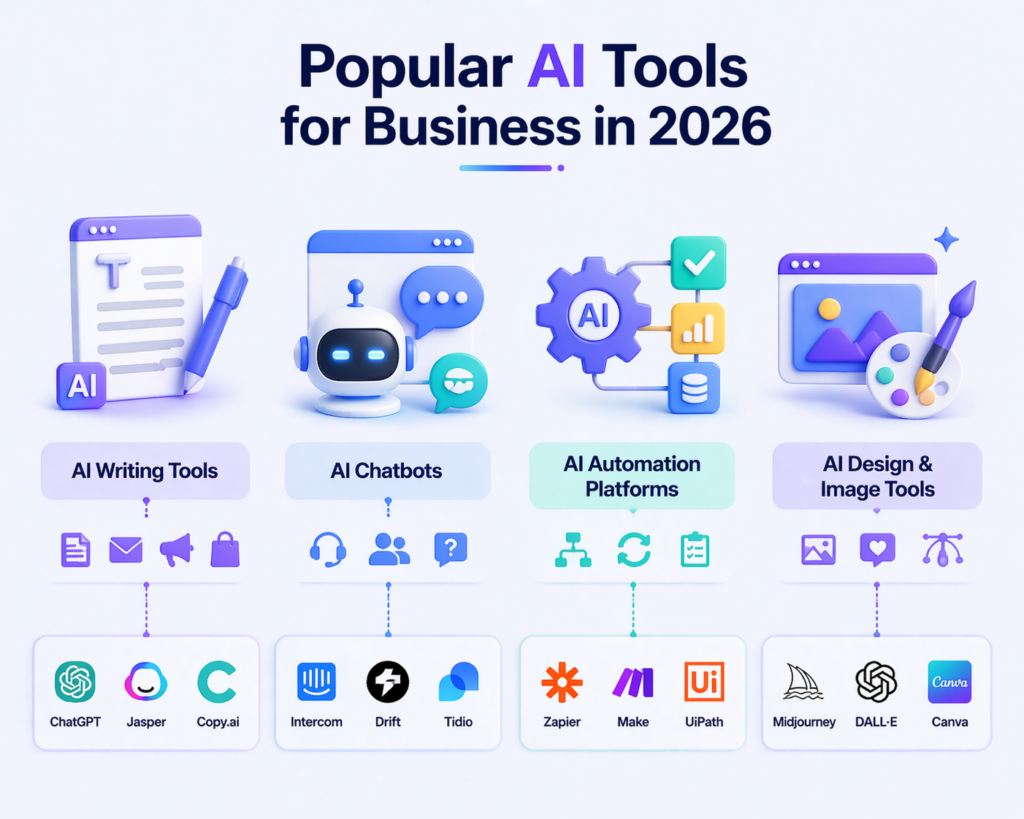
As AI adoption continues to grow, the number of tools available has expanded rapidly. Instead of focusing only on individual products, it’s more useful to understand the categories of AI tools businesses are investing in—and where they fit into real workflows.
At the same time, looking at a few well-known examples can help make these categories more concrete.
AI Writing Tools
AI writing tools have become essential for marketing and communication teams. They are designed to generate and assist with written content, helping businesses keep up with the growing demand for blogs, emails, ads, and product descriptions.
These tools are commonly used for:
- Blog content and articles
- Email campaigns
- Ad copy and landing pages
- Product descriptions
Popular examples in this category include ChatGPT, Jasper AI, and Copy.ai.
Their primary role is to remove the bottleneck of content creation and enable teams to scale output efficiently without sacrificing quality.
AI Chatbots
AI chatbots are now a standard feature for many digital businesses, especially those that rely heavily on customer interaction.
They are typically used for:
- Customer support
- Lead generation
- Website assistance and user guidance
Tools like Intercom, Drift, and Tidio are widely used in this space.
Their value lies in providing instant responses and handling high volumes of interactions without requiring a large support team, making them especially useful for scaling businesses.
AI Automation Platforms
AI automation tools focus on connecting different systems and streamlining workflows across departments.
They are commonly used for:
- Process automation
- Data syncing between tools
- Task and workflow management
Well-known platforms include Zapier, Make (Integromat), and UiPath.
These tools help businesses reduce manual work, minimize errors, and ensure that operations run smoothly without constant intervention.
AI Design and Image Tools
Visual content plays a critical role in marketing, and AI tools are making it easier and faster to produce high-quality designs.
These tools are used to create:
- Ad creatives
- Social media visuals
- Branding assets
- Product images
Popular tools in this category include Midjourney, DALL·E, and Canva.
They allow businesses to experiment with creative ideas quickly and reduce reliance on traditional, time-intensive design processes.
How to Choose the Right AI Tools for Your Business
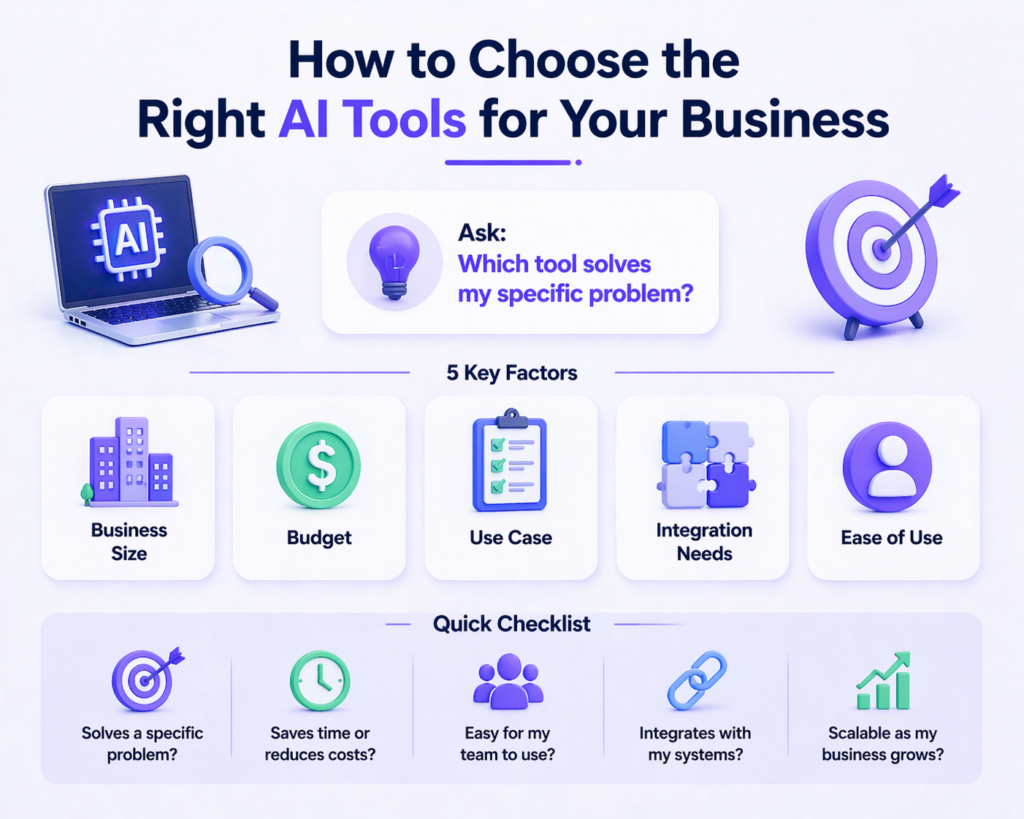
With so many options available, choosing the right AI tools can feel overwhelming. The key is to approach this as a strategic decision rather than a trend-driven one.
Instead of asking “Which tool is best?”, ask:
Which tool solves my specific problem?
A Simple Decision Framework
When evaluating AI tools, consider the following factors:
- Business Size
A small business may need simple, easy-to-use tools, while larger organizations might require more advanced systems with customization.
- Budget
AI tools vary widely in pricing. It’s important to balance cost with expected value and ROI.
- Use Case
Be clear about what problem you are trying to solve—content creation, automation, analytics, or customer support.
- Integration Needs
The tool should work seamlessly with your existing systems (CRM, marketing platforms, etc.).
- Ease of Use
A powerful tool is only valuable if your team can actually use it effectively.
Quick Checklist Before Choosing an AI Tool
Before deciding, ask yourself:
- Does this tool solve a specific business problem?
- Will it save time or reduce costs?
- Can my team use it without heavy training?
- Does it integrate with my current systems?
- Is it scalable as my business grows?
This simple checklist helps avoid unnecessary complexity and ensures you choose tools that actually add value.
Mistakes Businesses Make with AI Tools
While AI tools offer significant advantages, many businesses fail to see real results—not because the tools don’t work, but because of how they are implemented and used.
- Over-reliance on Automation
Expecting AI to completely replace human input can lead to poor outcomes. AI works best as a support system that enhances human decision-making, not a full replacement.
- Lack of Clear Strategy
Adopting AI tools just because they are trending often results in wasted time and resources. Without a defined use case or goal, even the best tools can underperform.
- Ignoring Data Quality
AI tools depend heavily on data. If the input data is inaccurate, incomplete, or inconsistent, the results produced by the tool will also be unreliable.
- Not Training Teams Properly
Even user-friendly AI tools require basic understanding and proper usage. Without training, teams may not be able to fully leverage the tool’s capabilities.
- Using Too Many Tools at Once
Implementing multiple AI tools without a clear system can create confusion and inefficiency. It’s often better to start with a few focused tools and scale gradually.
Challenges & Limitations of AI Tools
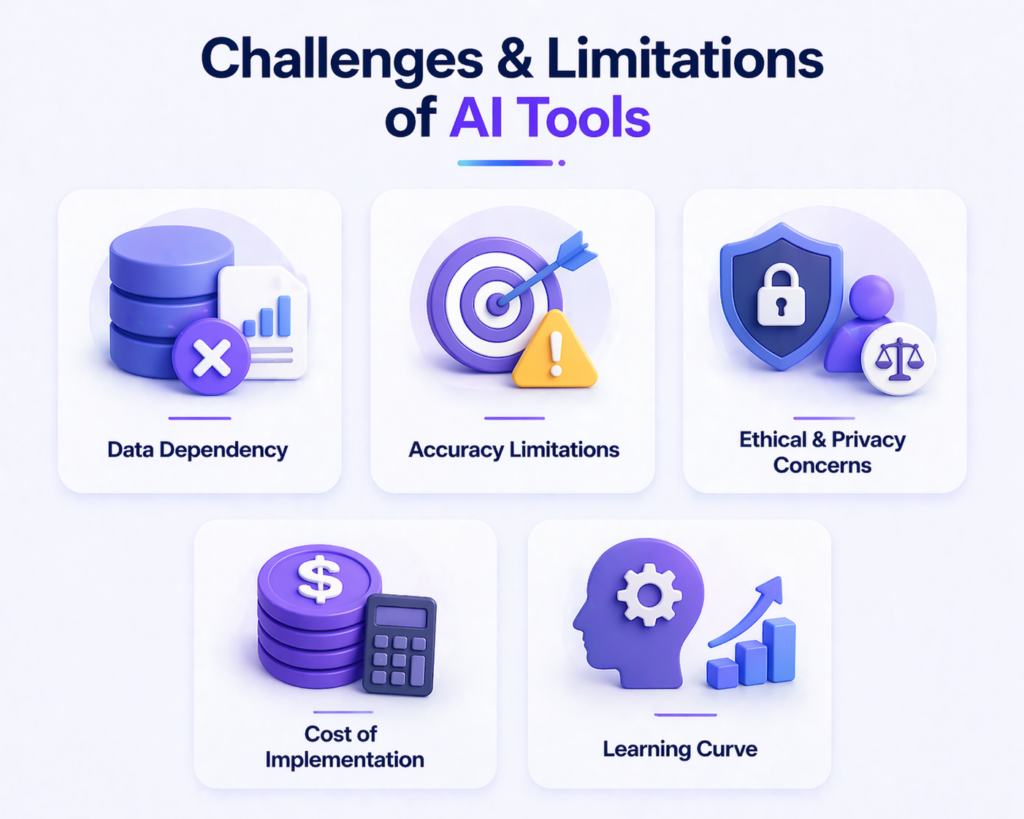
Despite their many benefits, AI tools are not without limitations. Understanding these challenges helps businesses set realistic expectations and use AI more effectively.
- Data Dependency
AI systems rely heavily on the data they are trained on. If the data is poor, outdated, or inconsistent, the results produced by the tool will also be unreliable.
- Accuracy Limitations
While AI tools are highly capable, they are not perfect. Outputs can sometimes be incorrect or incomplete, which is why human review is still important—especially for critical tasks.
- Ethical and Privacy Concerns
As AI adoption grows, issues such as data privacy, bias, and transparency become more important. Businesses need to ensure responsible and ethical use of AI tools.
- Cost of Implementation
Although many AI tools are affordable, more advanced systems or large-scale implementations can require significant investment in tools, infrastructure, and integration.
- Learning Curve
Teams need time to understand and adapt to new AI tools. Without proper onboarding and integration into workflows, businesses may not fully benefit from their capabilities.
The Future of AI Tools in Business (2026 and Beyond)
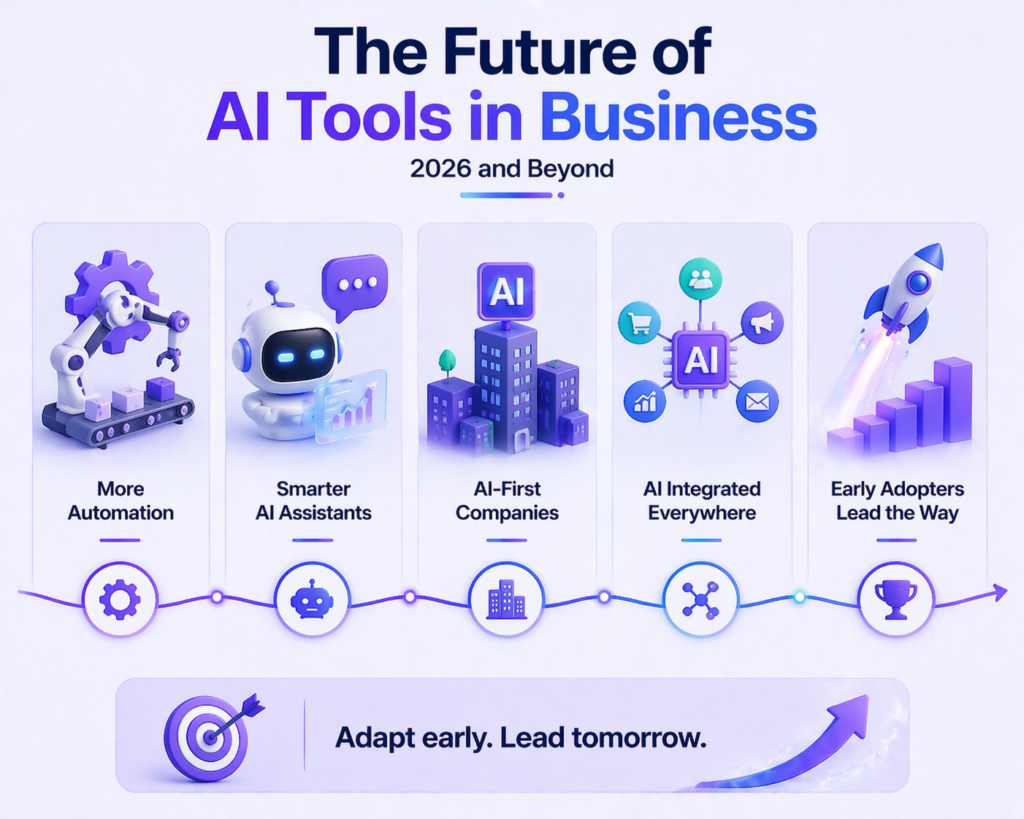
AI tools are evolving rapidly, and their role in business is only expected to grow.
One clear trend is increased automation. More processes will become automated, reducing the need for manual intervention across departments.
We are also seeing the rise of smarter AI assistants—tools that not only perform tasks but actively support decision-making and strategy.
Another major shift is toward AI-first companies. These businesses are built around AI from the ground up, using it as a core part of their operations rather than an add-on.
Perhaps most importantly, AI will become deeply integrated across all departments. Instead of being limited to specific use cases, it will be embedded into everyday workflows.
The businesses that adapt early will have a significant advantage in this evolving landscape.
Conclusion
AI tools are no longer optional—they are becoming a core part of how modern businesses operate.
From automating repetitive tasks to improving decision-making and enabling scalability, these tools offer a clear path toward greater efficiency and growth. Businesses that adopt AI strategically are not just saving time—they are building systems that allow them to compete more effectively in a fast-changing environment.
The key is not to adopt AI blindly, but to use it with purpose. Start with a clear problem, choose the right tools, and integrate them into your workflow gradually.
As we move further into 2026 and beyond, one thing is clear:
Businesses that learn how to leverage AI tools effectively will be better positioned to adapt, scale, and succeed in the future.
Key Takeaways
- AI tools are transforming how businesses operate by combining automation, data analysis, and intelligent decision-making
- They help improve productivity, reduce costs, and enable businesses to scale more efficiently
- Different types of AI tools serve different functions—from content creation and customer support to analytics and workflow automation
- Success with AI depends on using it strategically, not just adopting it because it’s trending
- Data quality, proper implementation, and team understanding play a major role in getting real results
- Businesses that start early and integrate AI gradually will have a stronger competitive advantage in the long run
FAQs
What are AI tools in simple terms?
AI tools are software programs designed to perform tasks that normally require human thinking. Instead of just following fixed instructions, they can analyze information, recognize patterns, and improve their performance over time. In a business setting, this might look like a tool that writes content, answers customer questions, or recommends products based on user behavior. The key idea is that these tools don’t just execute tasks—they learn from data and become more effective the more they are used.
How do AI tools help businesses?
AI tools help businesses by making everyday operations faster, more efficient, and more scalable. Instead of spending hours on repetitive tasks like writing emails, analyzing reports, or responding to common customer queries, teams can rely on AI to handle a large portion of that workload. This not only saves time but also allows employees to focus on higher-value activities such as strategy, creativity, and decision-making. Over time, this shift leads to better productivity, lower costs, and improved overall performance.
Are AI tools expensive for businesses?
The cost of AI tools can vary widely, but they are no longer limited to large enterprises with big budgets. Many modern tools are available through affordable subscription models, and some even offer free versions with basic features. For small businesses, this makes it possible to start using AI without a significant upfront investment. What matters more than the price is the value the tool provides—if it saves time, reduces manual effort, or improves results, it often justifies the cost fairly quickly.
What is the difference between AI and automation?
Automation and AI are closely related, but they are not the same. Automation is based on predefined rules—it performs tasks exactly as instructed without changing or learning. AI, on the other hand, introduces intelligence into the process. It can analyze data, adapt to new inputs, and make decisions based on patterns. In simple terms, automation follows instructions, while AI learns from experience. Many modern business systems combine both, using AI to make automation more flexible and effective.
Can small businesses use AI tools effectively?
Yes, and in many cases, small businesses benefit the most from AI tools. Since these tools can handle tasks that would otherwise require additional staff, they allow smaller teams to operate more efficiently without increasing costs. For example, a small business can use AI to generate marketing content, automate customer responses, or manage workflows—all without needing a large team. This levels the playing field and allows smaller companies to compete with larger organizations.
What industries benefit most from AI tools?
AI tools are not limited to a specific industry—they are useful anywhere there is data, customers, or processes to manage. Businesses in marketing, e-commerce, finance, healthcare, and customer service have already seen significant benefits from adopting AI. However, the reality is that AI is becoming universal. Whether it’s analyzing trends, improving customer experience, or automating operations, almost every industry can find ways to use AI tools to improve efficiency and decision-making.
Do AI tools replace human jobs?
AI tools are more likely to change how people work rather than replace them entirely. They take over repetitive and time-consuming tasks, which allows humans to focus on areas that require creativity, judgment, and strategic thinking. For example, instead of writing content from scratch, a marketer might use AI to generate a draft and then refine it. In this way, AI becomes a support system that enhances productivity rather than a replacement for human roles.
How accurate are AI tools?
AI tools can be highly accurate, especially when they are trained on high-quality data. However, they are not perfect and can sometimes produce incorrect or incomplete results. The level of accuracy often depends on how the tool is used and the type of task it is performing. For important decisions or critical content, it is still important to have human oversight. The best approach is to treat AI as a powerful assistant rather than a completely independent system.
How can a business get started with AI tools?
The most effective way to start using AI tools is by focusing on a specific problem rather than trying to implement everything at once. For example, a business struggling with content creation might begin with an AI writing tool, while one dealing with high customer support volume might start with a chatbot. Once the initial use case proves valuable, it becomes easier to expand into other areas. This gradual approach ensures that AI is adopted in a practical and sustainable way.
About Software Chronicle: Your Guide to Smarter Software Decisions
Software Chronicle is built to simplify how businesses understand and use software.
In a digital world filled with endless tools, platforms, and technologies, making the right decision can quickly become overwhelming. Our goal is to cut through that noise and provide clear, practical, and well-researched insights that actually help businesses move forward.
We focus on breaking down complex topics, whether it’s AI tools, CRM systems, marketing software, or automation platforms, into content that is easy to understand and actionable. Instead of just listing features, we explain how these tools work, where they fit, and how they can create real impact in a business environment.
At its core, Software Chronicle is designed for:
- Business owners trying to scale efficiently
- Marketers looking for better tools and strategies
- Teams aiming to improve productivity and workflows
Every piece of content we publish is built around one principle: helping you make smarter software decisions without confusion or guesswork.
As the software landscape continues to evolve, especially with the rapid growth of AI, our mission is to stay ahead of trends and provide insights that keep you informed, prepared, and competitive.
If you have any questions, suggestions, or would like to get in touch, feel free to contact us; we’d love to hear from you.

Najm Us Sahar Fareed is part of the editorial team at Software Chronicle, a group of SaaS researchers and former software buyers who have collectively evaluated over 200 tools across the categories we cover. With 5 years of experience working with digital marketing agencies across North America, she brings a strong background in content strategy and practical software evaluation.
AI Tools
AI Tools for Small Business: Where to Actually Start (2026)
Most small business owners are not asking whether to use AI anymore. They are staring at a dozen tabs, each one promising to be “the AI tool your business needs,” and closing the laptop no closer to an answer than when they opened it.
That confusion is the actual barrier now, not access or cost. The U.S. Chamber of Commerce’s 2026 small business report found that most small business leaders believe AI will help their daily work, and the real challenge has shifted from availability to moving past experimentation into structured use. Forbes Advisor’s own AI research backs this up from the broader business side: nearly three out of four businesses have started using AI for at least one business function, with half using it for two or more.
This guide is the starting point that cuts through the noise: which AI tools actually save a small business time today, in plain categories, with the honest limits included.
Quick Takeaways
- Nearly 3 in 4 businesses now use AI for at least one function, and half use it for two or more, according to Forbes Advisor.
- The U.S. Chamber of Commerce found small businesses see AI’s biggest current value in saving time, cutting costs, and finding new opportunities, with the shift from “experimentation to adoption” identified as the key next step.
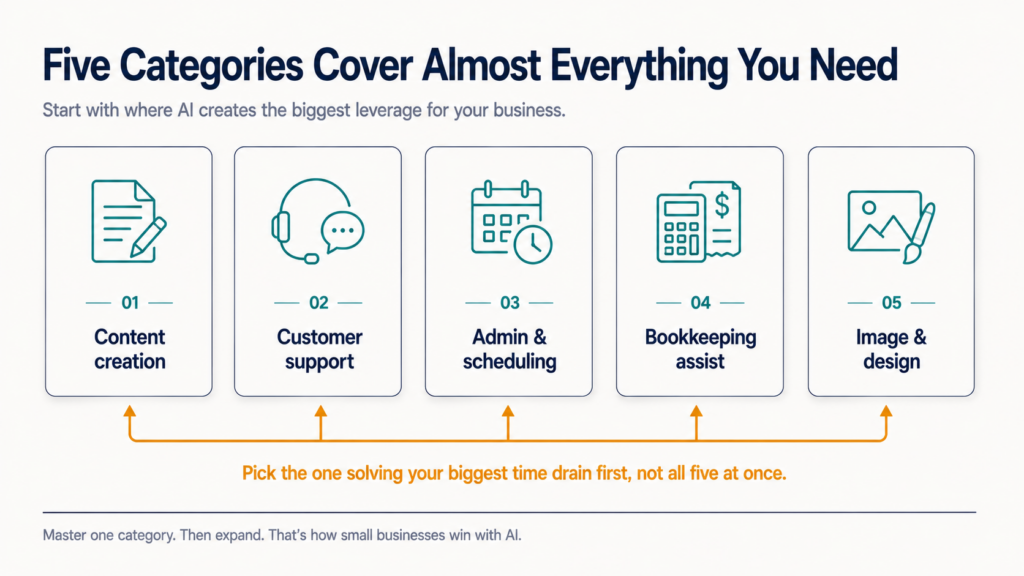
- Five categories cover almost everything a small business actually needs to start: content creation, customer support, admin and scheduling, bookkeeping assistance, and image or design generation.
- Free plans are genuinely usable starting points across every category below; the upgrade decision should wait until a specific limit (volume, features, or quality) actually gets hit.
- No AI tool replaces judgment on pricing, legal, financial, or hiring decisions. Treat AI output in those areas as a draft to review, never a final answer.
The 5 Categories Worth Starting With
Nearly every practical AI use case for a small business falls into one of five categories: content creation, customer support, admin and scheduling, bookkeeping assistance, and image or design generation, and starting with the category matching your single biggest time drain beats trying all five at once.
| Category | What It Actually Does | Free Plan Available? | Best Starting Tool |
| Content creation | Drafts blog posts, social captions, product descriptions, emails | Yes | ChatGPT, Claude |
| Customer support | Answers common questions, drafts replies, routes tickets | Yes (capped) | Freshdesk Free, Intercom Fin trial |
| Admin & scheduling | Drafts meeting notes, schedules calls, summarizes emails | Yes (limited) | Google Gemini (Workspace), Motion |
| Bookkeeping assistance | Categorizes expenses, flags anomalies, drafts summaries | Yes (basic tier) | QuickBooks Online with AI features |
| Image & design generation | Product photos, social graphics, ad creative drafts | Yes (credit-limited) | Canva AI tools |
Starting With AI Content Creation
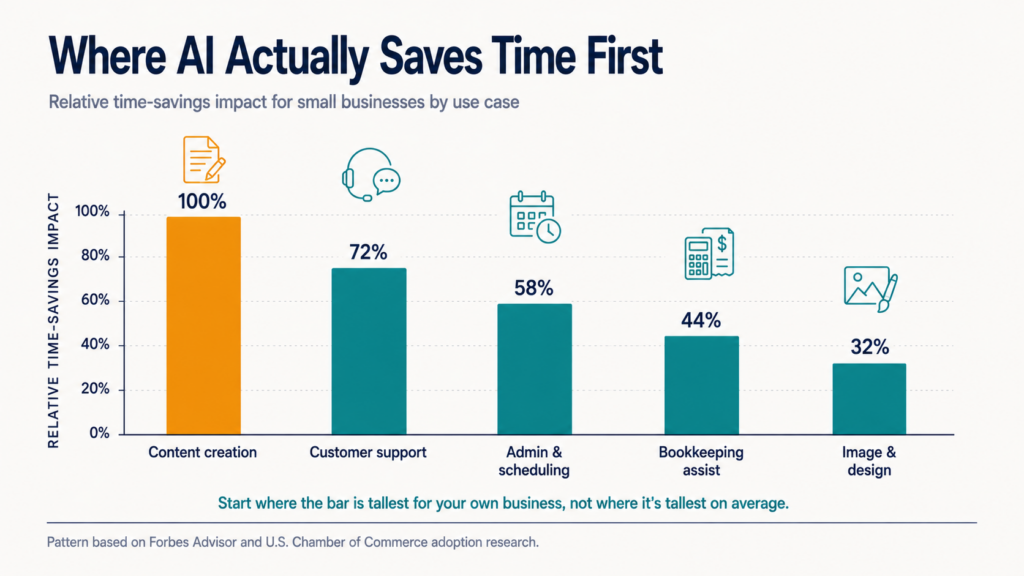
Content creation is the highest-adoption AI use case among small businesses because the time savings are immediate and the risk of a bad output is low, a draft, not a live decision.
ChatGPT and Claude both handle blog drafts, social captions, product descriptions, and email copy from a plain-English prompt, with genuinely usable free tiers.
- Start with the writing you do most often: product descriptions, email replies, or social captions, not the most ambitious piece you can imagine
- Give the AI real context: your brand voice, your audience, three examples of writing you like, not just a bare topic
- Treat the first draft as 70% done, not finished; the editing pass is still yours
For a deeper look at where AI content tools specifically fit into a broader writing workflow, see our guide to AI writing tools for content teams.
Starting With AI Customer Support
AI customer support tools answer repetitive questions (hours, shipping, returns) instantly and hand off anything complex to a human, which is exactly the workload split a small business without a dedicated support team needs.
Most modern help desks, including Freshdesk and Intercom, now build a chatbot layer directly into their existing free or entry tiers rather than selling it as a wholly separate product.
Read Also: Best AI Chatbot Builder for Business in 2026
The realistic starting move: turn on the AI answer feature inside a help desk you already use (or a free tier of one), point it at your existing FAQ page or return policy, and let it handle the questions that currently eat your inbox every single day before you build anything more elaborate.
Starting With AI for Admin and Scheduling
Admin AI tools summarize meetings, draft calendar invites, and turn a messy inbox into a prioritized list, work that is tedious but low-risk, which makes it a safe second category to adopt after content or support.
Google Gemini inside Google Workspace drafts email replies and summarizes long threads for businesses already on Google’s ecosystem. Dedicated scheduling assistants like Motion go further, actively rearranging your calendar around priorities rather than just logging what you tell it.
Starting With AI Bookkeeping Assistance
AI features inside accounting software categorize expenses, flag unusual transactions, and draft plain-English summaries of your financial position, meaningfully reducing manual data entry without replacing your accountant’s judgment.
QuickBooks Online’s AI features increasingly handle transaction categorization and anomaly flagging automatically as part of its existing tiers, covered in more depth in our accounting software buying guide.
The honest boundary here matters: AI can draft and flag, but tax filing, financial strategy, and anything with legal or compliance weight still needs a human accountant reviewing the output, not just approving it on sight.
Starting With AI Image and Design Generation
AI image tools generate social graphics, ad concepts, and basic product visuals from a text prompt, which is genuinely useful for a business with no design budget, provided the output is treated as a draft rather than a finished, publication-ready asset.
Canva’s built-in AI tools are the easiest starting point for a non-designer, since they sit inside a tool most small businesses already use for basic graphics.
What Free AI Plans Actually Get You
Every category above has a genuinely usable free tier, and the honest advice is to run every one of them for at least two weeks before paying for anything.
Free plans typically cap message volume, resolution quality, or advanced features, not core functionality, which means a small business can validate real value before committing budget.
- Free tiers are built to be outgrown on volume or polish, not on core capability
- The upgrade signal is a specific limit you actually hit, not a vague sense you “should” pay
- Running two weeks free costs nothing and tells you more than any review, including this one
Frequently Asked Questions
Which AI tool is best for starting a business?
Rather than one universal answer, the practical starting sequence for a brand-new business is: a general assistant (ChatGPT or Claude) for everything from business plans to marketing copy, plus one category tool matching your single most time-consuming task, whether that’s customer questions, scheduling, or bookkeeping.
Adding a third or fourth tool before the first two are genuinely embedded in your routine usually creates more confusion than value.
What is the 30% rule for AI?
There isn’t one widely recognized, formally defined “30% rule for AI”; the phrase shows up in a few different contexts (some marketing guides suggest capping AI-drafted content at roughly 30% of final published output without a human rewrite pass, for instance) without a single authoritative source.
If you’ve seen this phrase used somewhere specific, treat it as that source’s internal guideline rather than an industry standard, and the safer universal practice is simply: AI drafts, a human always reviews and edits before anything goes out under your business’s name.
Which AI business can I start?
Realistic AI-adjacent small business models include offering AI-assisted services (content writing, virtual assistant work, or basic automation setup for other small businesses), building niche tools on top of existing AI APIs, or consulting on AI adoption for businesses still in the experimentation phase this guide describes.
Any framing that suggests starting an “AI business” requires no skill, effort, or ongoing work is worth treating with real skepticism.
Which 3 jobs will survive AI?
Roles requiring in-person trust, physical skill, and complex human judgment are consistently rated most resistant to AI automation: skilled trades (electricians, plumbers), healthcare roles involving hands-on patient care, and senior roles requiring accountability and relationship-based judgment, such as executive leadership and high-stakes client management.
The common thread across all three is that AI can assist with the paperwork and communication around these jobs while the core work itself still needs a human physically or relationally present.
How can I make $1,000 a day using AI?
There is no reliable, repeatable way to make $1,000 a day using AI tools alone, and any claim promising a fixed daily income from AI specifically should be treated with real skepticism.
AI tools genuinely help existing businesses cut costs and save time, which is the actual, well-documented value this guide covers, but income still depends on your product, your customers, and your effort; AI changes how efficiently you can produce and support a real business, it does not manufacture income out of a prompt.
What are the 5 most popular AI tools?
Among small businesses broadly, the most widely adopted AI tools in 2026 are ChatGPT and Claude for general assistance and content, Canva’s AI features for design, Google Gemini for Workspace-integrated admin tasks, and AI chatbot features built into help desk platforms like Freshdesk and Intercom for customer support.
Popularity is a reasonable starting point for a shortlist, but the category-fit approach covered earlier in this guide matters more than which tool ranks highest overall.
Start With One Problem, Not Every Tool
Software Chronicle is an independent SaaS research publication. AI tool adoption succeeds when it solves one real, specific time drain, and fails when it becomes a collection of subscriptions nobody in the business actually uses.
Our recommendations stay independent of our partnerships. See how in our affiliate disclosure, read our review methodology, or contact us if you want an AI tool shortlist built around your specific business.
Najm Us Sahar Fareed is part of the editorial team at Software Chronicle, a group of SaaS researchers and former software buyers who have collectively evaluated over 200 tools across the categories we cover. With 5 years of experience working with digital marketing agencies across North America, she brings a strong background in content strategy and practical software evaluation.
AI Tools
How AI Tools Work: A Plain-English Explanation (No Math, Promise)

You type a question. You hit Enter. Three seconds later, a machine writes you a better answer than your group chat ever has.
Somewhere between the Enter key and that answer, something genuinely strange happens. And almost nobody who uses AI every day can explain what. That is not a knock on anyone; the industry buries the explanation under words like “transformer architecture” and “inference,” then acts surprised when people either fear AI or worship it.
Here is the secret: the core idea fits in one sentence, and you already understand the hard part because you do it yourself every day. By the end of this guide, you will know exactly what happens in those three seconds, what all nine pieces of jargon actually mean, and why AI tools are simultaneously brilliant and capable of confidently telling you that Australia has two moons.
No math. Promise.
Quick Takeaways
- AI tools are pattern-prediction machines: they learned patterns from enormous amounts of text and generate answers by predicting one small word-piece at a time.
- This is no longer niche knowledge. 88% of organizations now use AI in at least one business function, up from 78% a year earlier, according to McKinsey’s State of AI survey.
- Adoption outpaced every technology before it: Stanford’s 2026 AI Index reports generative AI reached 53% of the population faster than the PC or the internet, and estimates its value to US consumers at $172 billion annually.
- The nine terms that unlock everything: training data, neural network, transformer architecture, token, prompt, inference, context window, temperature, and fine-tuning.
- AI does not “know” facts the way a database does; it predicts plausible text. That single distinction explains both its creativity and its confident mistakes.
How Does AI Work in Simple Words?
In simple words, AI tools work by studying billions of examples of text (or images, or audio), learning the statistical patterns in them, and then generating new responses by predicting what should come next, one small piece at a time, based on your prompt.
It is your phone’s autocomplete, scaled up a few billion times and trained on a meaningful fraction of everything humans have ever written.
Everything else in this article is just unpacking that sentence. Let’s walk through the nine pieces, in the order they matter.
What Is Training Data?
Training data is the mountain of text, code, images, and conversation an AI model studies before you ever meet it: books, websites, articles, forums, documentation.
During training, the model is shown this text with words hidden and asked, billions of times: what comes next? Every wrong guess adjusts it slightly. Repeat at unimaginable scale, and it gets eerily good at the game.
This is why training data quality is destiny. A model mostly learns the world its data describes, gaps, biases, and all. It is the same reason data quality decides everything in analytics: the output can only be as good as what went in.
What Is a Neural Network?
A neural network is the model’s structure: millions of simple number-crunching units organized in layers, where each layer detects slightly more abstract patterns than the last.
Despite the name, it is not a brain. Early layers might pick up on spelling and word fragments; middle layers on grammar and phrasing; deeper layers on things startlingly close to concepts, tone, and logic.
A useful mental picture: a very tall building of filters. Your text goes in the ground floor as raw characters and comes out the top floor as meaning. No single floor “understands” anything; understanding-like behavior emerges from all of them stacked together.
What Is the Transformer Architecture?
The transformer is the 2017 breakthrough design behind modern AI tools, and its superpower is attention: the ability to weigh every word in your text against every other word simultaneously.
Older AI read like a person with a flashlight, one word at a time, forgetting the beginning by the end. Transformers read like someone seeing the whole page at once, noticing that “it” in your sentence refers to “the invoice” from two paragraphs ago.
That is the whole trick. The T in ChatGPT literally stands for Transformer, and nearly every major AI tool you have touched since 2020 is built on this design.
What Is a Token?
A token is the bite-sized chunk AI actually reads and writes: usually a short word or a piece of a longer one, where “cat” is one token but “extraordinary” might be three.
Models do not see letters or words the way you do; they see numbered tokens. Roughly, 1,000 tokens is about 750 English words.
Tokens matter to you for one practical reason: everything is measured in them. Pricing, length limits, and the “memory” of your conversation are all counted in tokens, which brings us to what happens when you press enter.
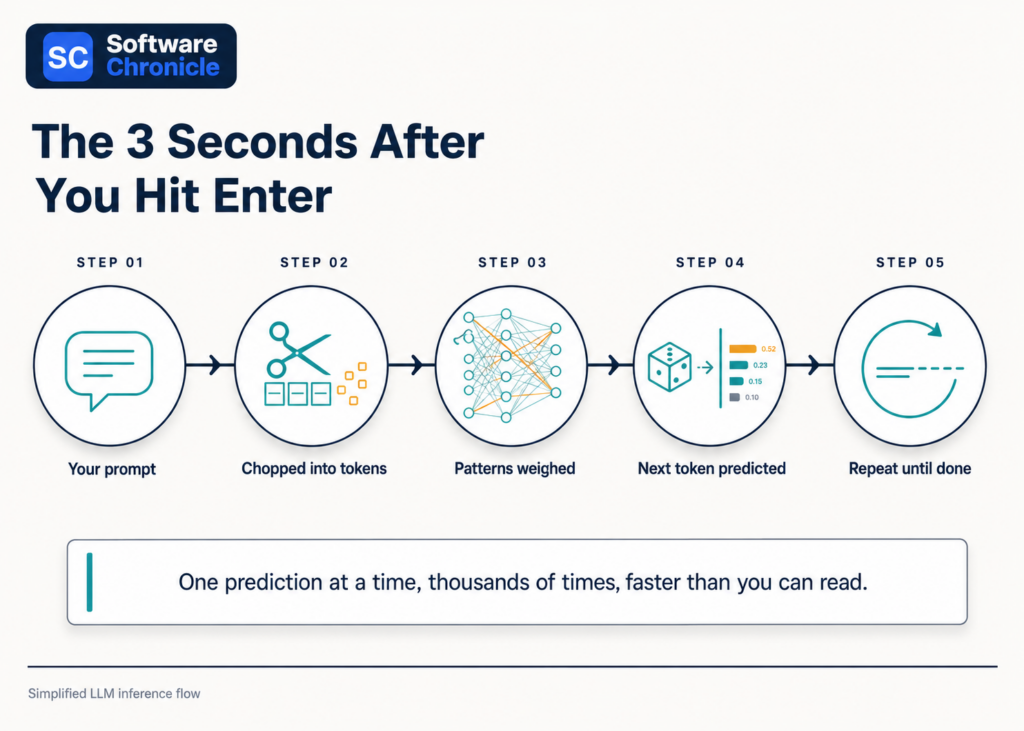
What Actually Happens When You Hit Enter? (Prompts and Inference)
Your prompt (the text you typed) gets chopped into tokens and fed through the network, and the model performs inference: predicting the single most fitting next token, appending it, and repeating until the answer is complete.
That fluid paragraph appearing on your screen was generated one token at a time, each prediction shaped by your prompt and everything generated so far.
This is also why prompt quality changes everything. The model is pattern-matching against your words; a vague prompt matches a million generic patterns, while a specific one (“explain this to a 10-year-old,” “respond as a skeptical lawyer”) narrows the prediction toward exactly the kind of text you want.
Working well with AI is mostly the skill of pointing to its predictions.
What Is a Context Window?
The context window is the model’s working memory: the maximum number of tokens (your conversation plus its replies) it can consider at once, and anything beyond it effectively falls off the whiteboard.
Modern tools have windows spanning hundreds of pages, but the principle holds: an AI does not remember your chat from last month by default. It rereads whatever fits in the window, every single time.
When a long conversation gets weird and the AI “forgets” your instructions from an hour ago, you have usually scrolled off the edge of its whiteboard. Starting a fresh chat with a clean summary often works better than pushing on.
What Is the Temperature Setting?
Temperature is the dial controlling how adventurous the model’s predictions are: low temperature always picks the safest next token, high temperature lets it gamble on less likely ones.
At temperature near zero, you get consistent, careful, sometimes boring output, ideal for factual summaries and code. Turned up, the model takes creative detours, ideal for brainstorming and fiction, with a rising risk of nonsense.
Most consumer chat tools set this for you behind the scenes. But now you know why the same question can produce a crisp answer today and a slightly unhinged one tomorrow: you are sampling from a probability distribution, not querying a database.
What Is Fine-Tuning?
Fine-tuning takes a fully trained general model and trains it further on a focused dataset, turning a generalist into a specialist: a support agent, a legal summarizer, a medical coder.
It is medical school after college. The base model already speaks the language; fine-tuning teaches it your domain, your tone, and your rules.
This is how AI shows up inside business software. The AI answering tickets in your help desk or surfacing churn risks in customer analytics platforms is typically a general model fine-tuned and constrained for one job, which is precisely why it behaves more reliably there than a blank chatbot would.
Read Also: What Is Business Intelligence Software? A Beginner to Pro Guide
Why Do AI Tools Get Things Confidently Wrong?
Because AI predicts plausible text rather than retrieving verified facts, it can generate statements that sound perfectly authoritative and are perfectly false, a failure mode known as hallucination.
The model is doing its job, completing the pattern beautifully; the pattern just happens to describe a court case that never existed. Nothing inside is checking against reality unless the tool is explicitly connected to search or a database.
The practical rule: treat AI output on facts the way you would treat a brilliant, well-read friend speaking from memory. Wonderful for drafts, explanations, and ideas; verify anything you plan to rely on. Notice, too, what McKinsey’s data shows: even with 88% of organizations using AI somewhere, nearly two-thirds have not scaled it enterprise-wide, and closing that trust gap is a large part of why.
Frequently Asked Questions
How does AI work in simple words?
AI works by learning patterns from billions of examples and then predicting the most fitting response to your input, one token at a time. It does not look up answers in a database; it generates them the way autocomplete suggests your next word, just with vastly more sophistication and context.
What is the AI tool and how does it work?
An AI tool is an application (like ChatGPT, Claude, or Gemini) built around a trained model: you provide a prompt, the tool runs inference through its neural network, and it streams back a generated response token by token. The app layer adds the chat interface, memory features, safety filters, and connections to search or files.
What is AI in 10 points?
AI in 10 points:
1) AI learns patterns from massive training data.
2) The model is a layered neural network.
3) Modern tools use the transformer architecture.
4) Text is processed as tokens, not words.
5) Your input is called a prompt.
6) Generating an answer is called inference.
7) The context window is its working memory.
8) Temperature controls how creative it gets.
9) Fine-tuning specializes a general model.
10) It predicts plausible text, so outputs need human verification.
How to work with AI tools?
Work with AI tools by giving specific prompts (role, audience, format, constraints), iterating instead of settling for the first draft, keeping important instructions inside the context window, and verifying factual claims before using them.
Treat it like a fast, talented junior colleague: excellent output, but you sign off on the final version.
Who is the father of AI?
John McCarthy, the American computer scientist who coined the term “artificial intelligence” in 1955 and organized the 1956 Dartmouth Conference that launched the field, is widely called the father of AI.
Alan Turing is honored as its intellectual grandfather for asking, years earlier, whether machines could think.
Is ChatGPT an AI tool?
Yes. ChatGPT is the most widely used AI tool: a chat application built on OpenAI’s GPT family of large language models, which are transformer-based neural networks trained on internet-scale text.
Everything in this guide (tokens, context windows, temperature, inference) describes exactly what happens each time it answers you.
Explanations Without the Hand-Waving
Software Chronicle is an independent SaaS research publication. We believe you make better software decisions when you understand how the machinery actually works, so we write the plain-English versions the vendors skip.
Curious how we evaluate the AI-powered tools we review? Our review methodology covers it, our affiliate disclosure covers how we fund it, and you can always contact us with a concept you want explained next.
Najm Us Sahar Fareed is part of the editorial team at Software Chronicle, a group of SaaS researchers and former software buyers who have collectively evaluated over 200 tools across the categories we cover. With 5 years of experience working with digital marketing agencies across North America, she brings a strong background in content strategy and practical software evaluation.
AI Tools
AI Tools for SEO: Do They Actually Work? (Tested & Ranked for 2026)
There is a version of this article that just lists five tools and calls it a day. This is not that article. The question of whether AI tools for SEO actually work is one that gets dodged constantly, replaced with feature screenshots and affiliate links that tell you nothing about what happens after you hit publish.
The honest answer is more interesting: some of them genuinely move rankings, some of them are expensive content spinners dressed up with dashboards, and knowing the difference is worth more than any individual subscription.
SEO has changed significantly. Google’s algorithms now evaluate topical clusters, entity optimization, and search intent alignment in ways that pure keyword stuffing never addressed. AI tools that understand this: that analyze semantic keywords, surface content gaps, and map out topic authority can genuinely accelerate results. Tools that don’t are just autocomplete with an SEO badge.
We’ve gone deep on the five platforms worth your attention to give you the full picture.
So, Do AI SEO Tools Actually Work?
Short answer: yes, selectively. Here’s the longer, more useful answer.
AI SEO tools work when they help you do things faster and smarter than you could manually.Tthings like identifying content gaps across hundreds of competitor pages, generating semantically relevant keyword clusters from a seed topic, optimizing content structure against top-ranking SERP results, and flagging missing entities that search engines associate with authority on a topic.
They don’t work when they’re used as a content replacement. Pages written entirely by AI with no editorial oversight, no real expertise, and no unique perspective are increasingly identifiable by both Google’s systems and human readers.
Google’s Helpful Content guidelines are explicit: content should demonstrate first-hand expertise and genuine value to the reader. AI tools that help you produce that kind of content faster? Valuable. AI tools that produce that content for you wholesale? A short-term shortcut with long-term ranking risk.
| The Rule of ThumbUse AI SEO tools to research smarter, structure better, and optimize more precisely, but write like a human who knows their subject. The tools in this list are ranked partly on how well they support that workflow. |
What the Data Says About AI in SEO
- 61% of marketers say AI is the most important aspect of their data strategy (Salesforce)
- Content optimized with AI SEO tools increases organic traffic by 40% to 60%. (TG)
- 82% of SEO professionals report using AI in their workflow as of 2026 (SQ Magazine)
- Pages that address search intent comprehensively earn 45% more organic traffic than keyword-matched pages alone (LLMrefs)
- The global AI in SEO market is projected to reach $32.6 billion by 2035, growing at 23.4% CAGR (Market.us)
Quick Takeaways
- Surfer SEO is the best tool for on-page content optimization — real-time scoring against live SERP data is its core strength
- Semrush is the most complete platform: keyword research, SERP analysis, content gap, site audit, and AI writing all in one
- Frase is the best value for content teams that need fast, research-driven brief creation and optimization
- MarketMuse is built for topical authority strategy — best for sites playing a long content game at scale
- NeuronWriter offers the strongest feature-to-price ratio for freelancers and small agencies
All 5 Tools: At a Glance
| Tool | Best For | AI Keyword Research | Content Optimization | SERP Analysis | Content Briefs | Starting Price |
|---|---|---|---|---|---|---|
| Surfer SEO | On-page optimization | Yes | Real-time scoring | Yes | Yes | $89/mo |
| Semrush | All-in-one SEO suite | Advanced | SEO Writing Assistant | Advanced | Yes | $139.95/mo |
| Frase | Brief creation + optimization | Yes | Yes | Basic | Excellent | $45/mo |
| MarketMuse | Topical authority | Advanced | Topic modeling | Yes | Advanced | $149/mo |
| NeuronWriter | Budget content optimization | Yes | SERP-based scoring | Yes | Yes | $23/mo |
Surfer SEO
| 🏄 Surfer SEOBest for on-page content optimization with real-time SERP scoring |
Surfer SEO built its reputation on one thing: real-time content scoring against the actual pages ranking on page one for your target keyword. You write inside Surfer’s editor, and as you type, it tells you whether your word count, heading structure, NLP term usage, and entity coverage are competitive with what’s already ranking. For teams serious about on-page optimization, it’s the closest thing to a live map of what Google wants to see.
What Surfer SEO Does Well
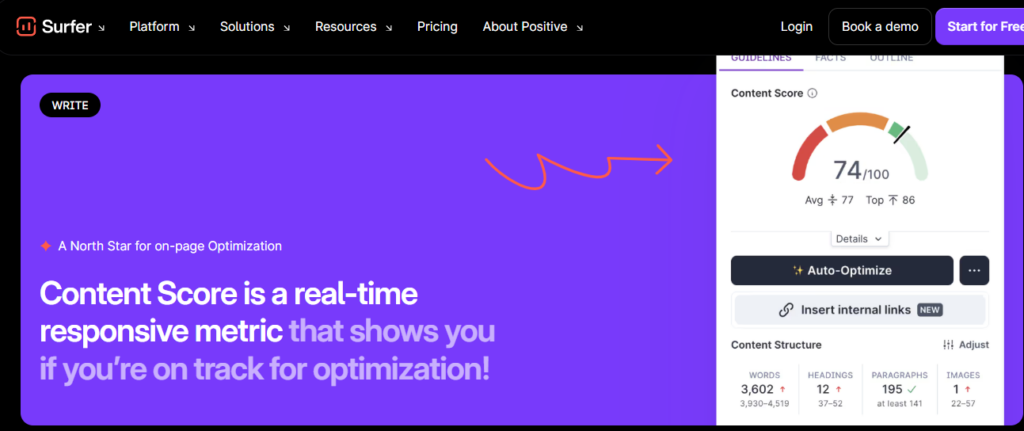
- Content Score: Surfer’s signature feature. A live 0-100 score that updates as you write, measuring how well your content matches the semantic keyword distribution, structure, and NLP signals found in top-ranking pages for your target keyword.
- SERP Analyzer: Breaks down the top 20 results for any keyword including word count, heading patterns, keyword usage, page speed, backlink counts, giving you a clear structural picture of what ranks.
- AI Content Outline: Generates a full content brief in seconds: H2/H3 structure, suggested word count, semantic keywords to include, and questions to answer based on live SERP data, not generic templates.
- Topical Map: A newer feature that identifies the full cluster of topics your site should cover to build authority in a niche, surfacing content gaps your competitors have already filled.
- Keyword Research: Clusters keyword ideas by semantic relevance and search intent so instead of a flat list of 500 terms, you get grouped topic clusters you can build content around strategically.
Where It Falls Short
- Backlink analysis is limited: Surfer is an on-page tool; for off-page SEO you’ll still need Ahrefs or Semrush
- The Content Score is a guide, not a guarantee: over-optimizing to hit 100 can produce stilted, keyword-heavy prose
- Entry plan limits the number of articles and team seats: agencies need the Scale plan or above
| Surfer SEO VerdictThe best pure on-page optimization tool available. If your content team publishes frequently and wants data-driven guidance on exactly what to write and how to structure it, Surfer delivers consistently. Pair it with a keyword research tool like Semrush for a complete workflow. |
| Plan | Price/mo | Key Inclusions |
|---|---|---|
| Essential | $99 | 30 articles/mo, Content Editor, Keyword Research |
| Scale | $182 | 100 articles/mo, AI Outline, SERP Analyzer, Topical Map |
| Scale AI | $219 | Full AI automation, bulk content creation, priority support |
| Enterprise | $999 | Unlimited, white-label, dedicated CSM |
Prices may vary depending on youe needs.
Semrush
| 📊 SemrushBest all-in-one AI SEO platform for keyword research, audits, and content |
Semrush is the closest thing SEO has to a single platform that does everything and actually does most of it well. Keyword research, competitor analysis, backlink auditing, rank tracking, site health, content optimization, and AI-assisted writing are all available under one login. For teams that don’t want to manage a stack of five different tools, Semrush is the logical home base.
What Semrush Does Well
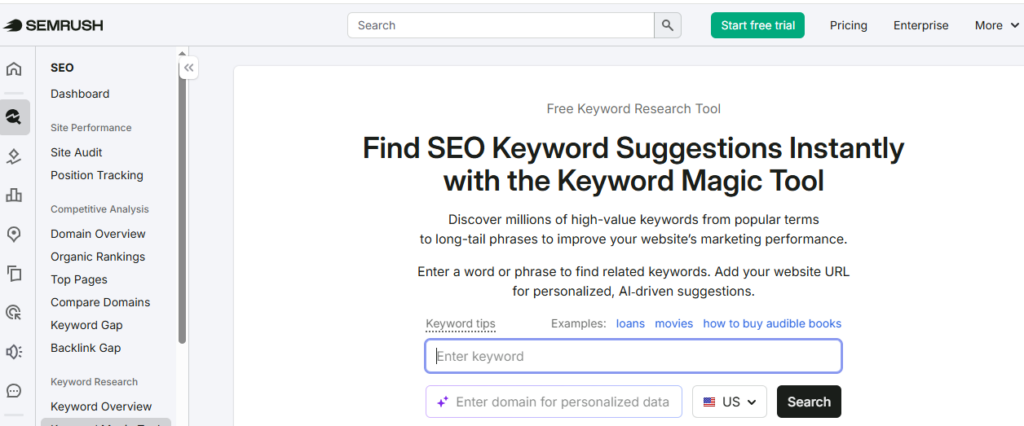
- Keyword Magic Tool: One of the largest keyword databases available with over 25 billion keywords and AI-powered filtering by intent (informational, navigational, commercial, transactional) and semantic clustering that groups related terms automatically.
- SEO Writing Assistant: Real-time content scoring similar to Surfer’s. It analyzes readability, target keyword usage, semantic keyword inclusion, tone of voice consistency, and originality against a live SERP benchmark.
- Content Gap Analysis: Enter your domain and up to five competitors. Semrush shows you every keyword your competitors rank for that you don’t. One of the most actionable content planning features in any SEO tool.
- AI Meta Description and Title Tag Generator: Generates optimized meta descriptions and title tags based on your target keyword and page content. One of the underrated time-savers for teams managing large content libraries.
- Topic Research: Enter a seed topic and get a full map of subtopics, related questions (pulled from PAA and forums), and trending headlines, essentially a content brief generator built on real search data.
Where It Falls Short
- Pricing is the highest on this list: the Pro plan starts at $117.335/mo, and most serious features require Guru or above
- Data overload is real: the platform is enormous, and new users often struggle to find the features most relevant to their workflow
- The SEO Writing Assistant, while useful, isn’t as deep as Surfer’s real-time content scoring for pure on-page optimization
| Semrush VerdictThe strongest platform in this comparison for teams that need keyword research, competitor analysis, technical SEO auditing, and content optimization in one place. The price is justified if you’re replacing multiple tools. For pure content optimization, Surfer is more focused but for a complete SEO workflow, Semrush covers more ground than anything else here. |
| Plan | Price/mo | Key Inclusions |
|---|---|---|
| Pro | $117.33 | 5 projects, 500 KW tracking, SEO Writing Assistant |
| Guru | $208.33 | 15 projects, Content Marketing Platform, historical data |
| Business | $416.33 | 40 projects, API access, white-label, extended limits |
Prices may vary.
| 📝 FraseBest for fast, research-driven content briefs and AI-assisted writing |
Frase occupies a sweet spot that the larger platforms miss: it’s fast, intuitive, and built specifically for the content brief-to-draft workflow. Where Semrush overwhelms with data and Surfer focuses tightly on scoring, Frase focuses on getting a writer from blank page to structured, well-researched draft as efficiently as possible. For content teams publishing at volume, this translates directly into hours saved per article.
What Frase Does Well
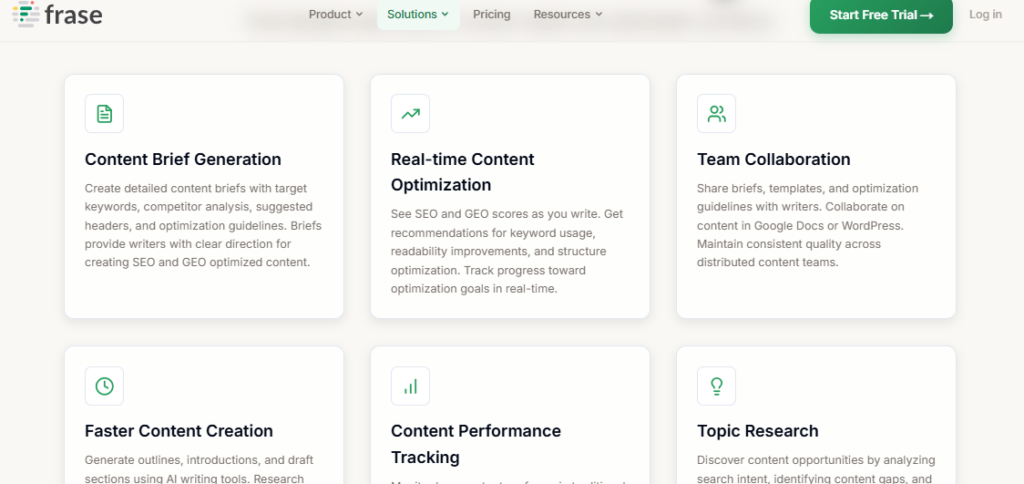
- AI Content Brief Generation: Frase analyzes the top 20 SERP results for your target keyword and builds a full content brief in under 30 seconds, including recommended headings, key statistics, questions to answer, and topics to cover based on what’s actually ranking.
- SERP Research Sidebar: While you write, the right-hand panel shows you exactly what each top-ranking competitor covers including, topics, statistics, key points so you can benchmark and fill gaps without leaving the editor.
- Topic Score: Similar to Surfer’s Content Score, Frase assigns a topic coverage score as you write, measuring whether you’ve covered the semantic entities and subtopics found across top-ranking pages.
- AI Writer: Built into the editor. It generates introductions, expands bullet points, rewrites sections, and completes partial paragraphs. More useful as a drafting accelerator than a full content generator.
- Questions Research: Aggregates PAA questions, Reddit threads, Quora discussions, and forum content related to your topic, ideal for building FAQ sections and identifying what real users are actually asking.
Where It Falls Short
- Keyword research depth is limited compared to Semrush. Frase is a content tool, not a full SEO suite
- AI-generated content quality is average; works best as a starting point rather than finished copy
- Backlink and technical SEO features are absent. You’ll need a separate tool for those
| Frase VerdictThe best tool in this comparison for content teams focused on research speed and brief quality. At $45/month for the Solo plan, it’s also the best value for writers and small agencies who need SERP-based optimization without the complexity or price of Semrush. Pair it with a dedicated keyword research tool for a complete workflow. |
| Plan | Price/mo | Key Inclusions |
|---|---|---|
| Starter | $49 | 1 user, 30 docs/mo, AI Writer, SERP research |
| Professionl | $129 | 3 users, unlimited docs, full brief generation |
| Scale | $299 | 5 users, advanced AI, team collaboration, priority support |
Prices may vary.
MarketMuse
| 🧠 MarketMuseBest for building topical authority and long-term content strategy at scale |
MarketMuse plays a different game to the other tools in this list. It’s not primarily a content editor or a keyword research tool. It’s a topical authority platform. Its core insight is that Google doesn’t just rank individual pages; it ranks sites that demonstrate comprehensive, authoritative coverage of a topic area. MarketMuse maps that territory for you, identifies where your site’s authority gaps are, and tells you exactly what to create to fill them.
What MarketMuse Does Well
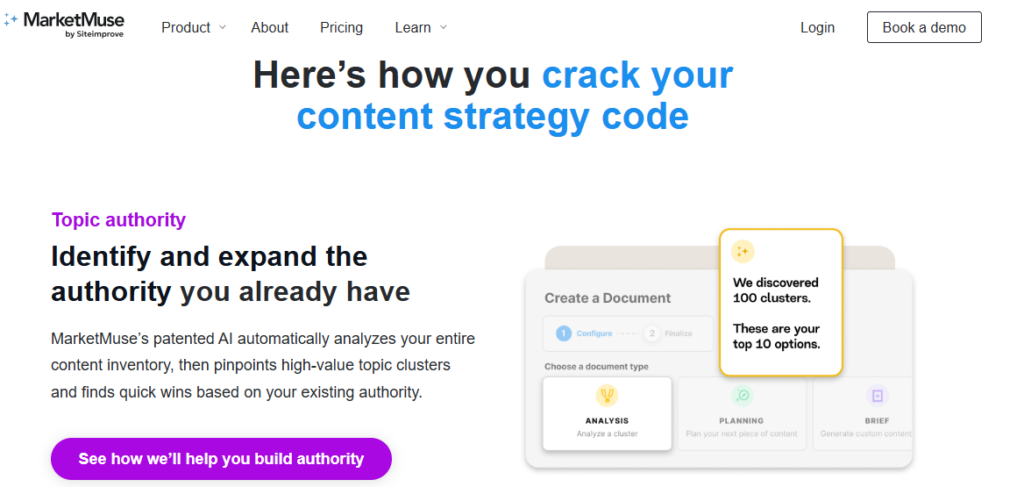
- Content Inventory and Audit: MarketMuse crawls your entire site and scores every page against topic coverage benchmarks, giving you a prioritized view of which existing pages need updating and which gaps represent your highest-value creation opportunities.
- Topical Authority Score: Measures how comprehensively your site covers a given topic relative to competitors, using a proprietary model trained on millions of pages. This is the clearest expression of entity optimization available in any tool.
- Topic Model: For any target keyword, MarketMuse generates a full topic model including every related entity, subtopic, and concept that search engines associate with authority on the subject. Invaluable for brief creation and editorial planning.
- Competitive Content Gap: Identifies specific content pieces your competitors have published that cover topics your site hasn’t addressed, mapped against your existing authority scores to prioritize impact.
- Content Briefs: The most detailed content briefs of any tool in this comparison with recommended word count, target KPIs, questions to answer, related topics to cover, internal linking suggestions, and competitor benchmarks.
Where It Falls Short
- Starting price of $149/month positions it above Surfer and well above Frase — hard to justify for individual bloggers or small teams
- The free plan is very limited — useful for evaluation but not practical workflow
- The depth of data can be overwhelming; MarketMuse takes longer to onboard than simpler tools
| MarketMuse VerdictThe most strategically sophisticated tool in this comparison. If you’re building a content-driven SEO strategy for a site with real scale ambitions — a media publication, a large SaaS blog, an authority site — MarketMuse’s topical modeling and authority scoring will inform decisions that simpler tools can’t. For smaller operations, the price-to-value ratio tips against it. |
| Plan | Price/mo | Key Inclusions |
|---|---|---|
| Free | $0 | 10 queries/mo, limited content briefs |
| Optimize | $149 | 100 queries/mo, full topic modeling, content briefs |
| Research | $249 | Unlimited queries, competitive analysis, inventory |
| Strategy | Custom | Full site audit, dedicated strategist, custom reporting |
Prices may vary.
| ⚡ NeuronWriterBest value AI SEO tool for freelancers, bloggers, and small agencies |
NeuronWriter is the tool that surprises people who’ve only heard of the bigger names. At $19/yearly for a fully functional plan, it delivers SERP-based content optimization, semantic keyword analysis, AI-assisted writing, and content brief generation that competes directly with tools charging three to five times as much. For freelancers, bloggers, and small agencies watching their software spend, it’s the most honest value in AI SEO software right now.
What NeuronWriter Does Well
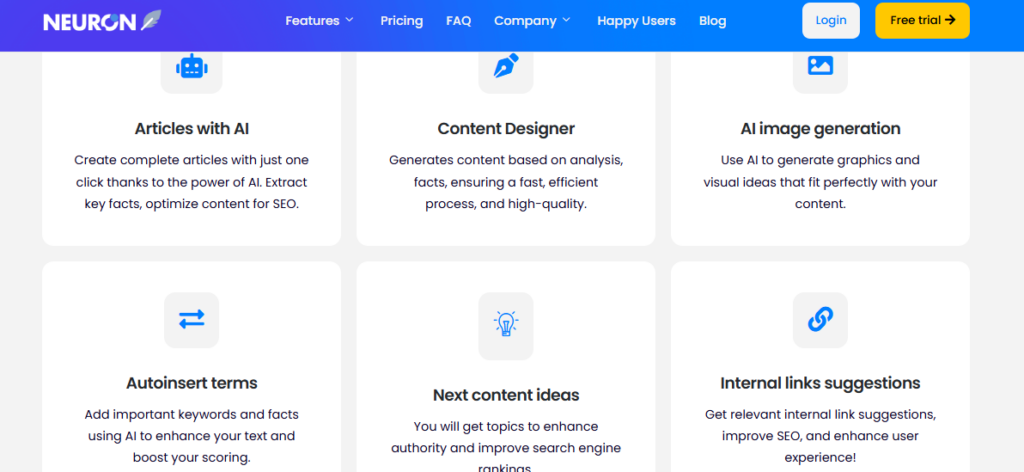
- NLP Content Optimization: NeuronWriter uses Google’s own Natural Language Processing API to identify the semantic terms and entities that top-ranking pages use and scores your content against that benchmark in real time, just like Surfer.
- SERP Analysis: Analyzes the top 30 ranking pages for your target keyword, breaking down their structure, word count, heading patterns, and NLP term usage, giving you a clear optimization target.
- Content Brief Builder: Generates structured content briefs based on SERP data, recommended headings, questions to answer, terms to include, and competitor gaps to fill.
- AI Writing Assistant: Built-in GPT-powered writing tools for generating introductions, expanding sections, rewriting paragraphs, and completing outlines, available without leaving the editor.
- Internal Linking Suggestions: Suggests relevant internal links from your existing content library as you write: a feature that many higher-priced tools don’t include.
Where It Falls Short
- No standalone keyword research tool: you’ll need Google Search Console, Ahrefs, or Semrush to identify keywords before bringing them into NeuronWriter
- UI is functional but less polished than Surfer or Frase
- Content scoring model is solid but not quite as sophisticated as MarketMuse’s topic modeling
| NeuronWriter VerdictThe best-kept secret in AI SEO tools. For anyone who finds Surfer’s pricing hard to justify or wants a Frase alternative that doesn’t compromise on core optimization features, NeuronWriter delivers remarkably well at a fraction of the price. The only real gap is keyword research. Pair it with Google Search Console or a free Semrush account to cover that base. |
| Plan | Price/mo (billed annually) | Key Inclusions |
|---|---|---|
| Bronze | $19 | 25 analyses/mo, AI writer, NLP optimization |
| Silver | $37 | 50 analyses/mo, content planner, SERP analysis |
| Gold | $57 | 75 analyses/mo, team access, advanced AI writing |
| Platinum | $77 | 150 analyses/mo, API, white-label, priority support |
Prices my vary.
Read Also: 9 Best AI Writing Tools for Content Teams in 2026
Head-to-Head: Which AI SEO Tool Wins on Each Use Case?
| Use Case | Winner | Why |
|---|---|---|
| On-page content optimization | Surfer SEO | Real-time SERP scoring is the most precise available |
| Keyword research + intent analysis | Semrush | 25B+ keyword database with AI clustering and intent filters |
| Content brief creation speed | Frase | 30-second SERP-based briefs; fastest research-to-brief workflow |
| Topical authority + content strategy | MarketMuse | Topic modeling and authority scoring go deeper than anyone else |
| Best value for budget | NeuronWriter | Full NLP optimization + AI writer at $23/mo is unbeaten |
| All-in-one single platform | Semrush | Covers more SEO use cases than any other tool here |
| Best for freelancers / solo bloggers | NeuronWriter / Frase | Both offer strong optimization features at accessible price points |
| Best for content agencies | Surfer SEO / Semrush | Scalable plans with team features and client project management |
| AI meta description + title tags | Semrush | Dedicated AI generator for meta content built into the platform |
| Search intent alignment | Frase / Surfer SEO | Both analyze SERP intent signals and structure briefs around them |
Which AI SEO Tool Is Right for You?
The right tool depends on your role, team size, and primary bottleneck:
- Freelance writer or solo blogger: Start with NeuronWriter. You get real NLP optimization and AI writing at a price that makes sense for one-person operations.
- Content manager publishing 10-30 posts/month: Frase is built for your workflow: fast briefs, research sidebar, topic scoring, and a usable AI writer at a price that scales.
- SEO specialist or strategist: Semrush for keyword research and competitor analysis, Surfer for on-page optimization. These two together cover the full workflow better than any single platform.
- Head of content at a growth-stage company: MarketMuse if topical authority is your strategic priority. Surfer if on-page quality and volume are the primary bottleneck.
- Agency managing multiple client sites: Semrush for its project management, white-label reporting, and breadth. Surfer as a writing-side add-on for production teams.
Didn’t find what you were looking for? Read: 11 Best AI Chatbot Builders for Business in 2026
Frequently Asked Questions
Are AI SEO tools worth it?
Yes, AI SEO tools are absolutely worth the investment, provided you use them as administrative accelerators rather than a replacement for strategy.
They dramatically lower costs often cutting technical workflows by up to 32% and eliminate hours of manual labor by scraping vast sets of data in seconds. If your goal is to scale competitor research, speed up site audits, or build rapid content outlines, the ROI is high. They lose their value entirely if you use them to blindly publish unedited automated content.
Can I use AI to help with SEO?
Yes, you can and should use AI to assist your SEO efforts to stay competitive. In fact, an Ahrefs study revealed that 86.5% of top-ranking web pages leverage AI-assisted processes in their workflow. The smartest ways to use AI for SEO include:
- Running instant technical site crawls to find broken links and broken schema.
- Mapping keyword clusters based on semantic search intent.
- Generating structured content outlines using real-time SERP data.
- Translating text and generating missing meta descriptions at scale.
What is the 10-20-70 rule for AI?
The 10-20-70 rule for AI states that successful digital transformation relies far more on people than technology. The percentage breakdown dictates that:
- 10% of your focus and effort goes into the algorithms and models.
- 20% goes toward the underlying data infrastructure and software platforms.
- 70% must be dedicated to the people, internal processes, and change management required to use those tools effectively.
Is SEO dead or evolving in 2026?
SEO is not dead; it is actively evolving into a hybrid discipline called Generative Engine Optimization (GEO). AI answers provided by tools like ChatGPT, Gemini, and Perplexity do not invent information out of thin air; they cite and pull data directly from highly optimized websites ranking in top traditional search positions. Traditional keyword stuffing is dead, but organizing high-quality data so AI agents can crawl and trust your site is more crucial than ever.
Is SEO replaceable by AI?
No, SEO cannot be fully replaced by AI because algorithmic optimization requires human judgment, context, and creative business strategy. While AI handles the execution of data-heavy tasks, it completely lacks the capacity for real-world relationship building, local market insight, and complex site migrations. Because search algorithms require human-centric verification, automated systems cannot replace the oversight needed to guide a brand’s strategy.
What is the 30% rule for AI?
The 30% rule for AI is a workflow framework specifying that AI should handle no more than 30% of a task or content piece, leaving the remaining 70% to human oversight, strategy, and creative editing. In content creation, adhering to this ensures your brand avoids generating generic “AI-slop” that search engines routinely filter out. It establishes a balanced human-machine partnership where the AI acts as a foundational support layer, not a solo creator.
Is ChatGPT good for SEO?
Yes, ChatGPT is excellent for SEO brainstorming, formatting, and analysis, but it is a poor choice for raw copy production. It excels at building programmatic outlines, spinning up regex formulas for Google Search Console, or clustering keywords by search intent. However, if you let it write your entire article without heavy editing, it lacks the original data, unique perspectives, and first-party expert quotes necessary to satisfy search ranking guidelines.
What is the 80/20 rule of SEO?
The 80/20 rule of SEO (the Pareto Principle) means that 80% of your search engine traffic will come from 20% of your content and keywords. In practice, this means webmasters should spend less time publishing a massive volume of low-performing pages, and instead dedicate the bulk of their optimization resources to protecting, updating, and building links to the core 20% of high-intent pages that actually drive business conversions.
Which 3 jobs will survive AI?
While technical workflows continue to shift, three broad categories of employment are highly resilient to AI automation due to their deep reliance on human traits:
- Strategic Leaders and Decision Makers: Roles requiring high-level ethical judgment, long-term vision, crisis management, and complex stakeholder negotiation.
- Creative Innovators and Researchers: Positions built on original problem solving, generating net-new scientific hypotheses, or writing unique thought-leadership pieces that do not yet exist on the internet.
- Empathy-Driven and Relational Specialists: Careers heavily anchored in emotional intelligence, deep human empathy, and relationship building, such as advanced behavioral therapists, complex negotiators, and community care leaders.
Research-Backed Reviews With Software Chronicle
Software Chronicle is an independent SaaS research publication testing software across SEO, marketing, CRM, HR, finance, customer support, and more. We go hands-on with every platform we cover, benchmark features against real workflows, and publish findings that help you make smarter software decisions.
Our editorial process is independent of the vendors we review. We evaluate platforms based on performance, not partnerships and we’re upfront about affiliate relationships so you always know where we stand.
Read how we approach reviews on our how we review software page, and check our disclaimer for full disclosure.
Have a question or a tool you’d like us to review? Contact us here.
Najm Us Sahar Fareed is part of the editorial team at Software Chronicle, a group of SaaS researchers and former software buyers who have collectively evaluated over 200 tools across the categories we cover. With 5 years of experience working with digital marketing agencies across North America, she brings a strong background in content strategy and practical software evaluation.
- CRM for Freelancers: Do You Really Need One?

- CRM for Real Estate Agents: Best Options

- CRM Integration Guide: Connect Your Tools Without Breaking Your Data

- CRM Pricing Guide: What Does CRM Software Actually Cost? (2026)

- Task Management vs Project Management: What’s the Difference?

- Project Management Methodologies: Agile vs. Scrum vs. Kanban vs. Waterfall
- Gantt Chart Software: Do You Need It? (An Honest Answer)

- CRM + Marketing Automation: How They Work Together

-

 Blog5 months ago
What Is Accounting Software? The Complete SMB Guide to Managing Finances
-
 Blog4 months ago
11 Best No-Code App Builders for Business in 2026
-

 Blog3 months ago
How to Choose Accounting Software for Your Business: The Ultimate Buyer’s Guide
-

 Blog3 months ago
How to Choose Project Management Software: A No-Nonsense Buying Guide for 2026
-

 Blog2 months ago
How to Choose Customer Support Software (Without Regretting It in Six Months)
-
 Blog4 months ago
9 Best No-Code Website Builders in 2026
-
 Blog4 months ago
11 Agile Project Management Tools — Full Guide for Modern Teams (2026)
-
 AI Tools4 months ago
9 Best AI Writing Tools for Content Teams in 2026